スキップしてメイン コンテンツに移動

Pythonでスペースを扱う


English ver


Introduction

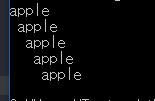
コマンドラインで次のような表示をさせたい。
apple
  apple
    apple
      apple
        apple

失敗

次のようなprintを使ったcodeでは失敗する
def main():
    i = 0
    while i<5:
        print('apple')
        j = 0
        while j < i:
            print(' ')
            j = j + 1
        i = i + 1
if __name__ == '__main__':
    main()
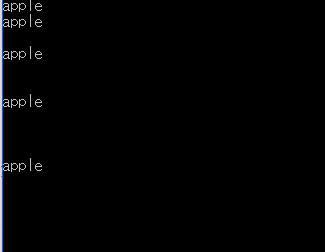
結果は、、、
enter image description here
Printは使うごとに改行してしまうのです。

成功

次のようなcodeを見てください。
import sys

def main():
    i = 0
    while i < 5:
        print('apple')
        j = 0
        while j <= i:
            sys.stdout.write(' ')
            j = j + 1
        i  = i + 1
if __name__ == '__main__':
    main()
sys.stdout.write は改行を無視してくれます。
結果!!
enter image description here
一つ注意することはsys.stdout.weiteはstrしか受け付けないことです。

Reference

https://www.lifewithpython.com/2013/12/python-print-without-.html

コメント

このブログの人気の投稿

カーネルK-means 理論編

Introduction English ver 今日は、カーネルK-meansの理論について書きます。カーネルK-meansは通常のK-meansの欠点を補うことができます。通常のK-meansの欠点とカーネルK-meansの強みも説明します。もし、まだ御覧になられていなければ、通常の K-means 理論編 の記事を見ていただけるとよいのではないかと思います。 カーネルK-meansの実装編 も併せてご覧ください。 概要 K-meansの弱点 カーネルトリック カーネルK-means アルゴリズム K-meansの弱点 例えば、次のようなデータを用意します。 このデータはK-meansによってうまく分類することはできません。なぜなら通常のK-meansでは、データとプロトタイプのユークリッド距離に依存しているからです。そのため、このような円状に分布しているデータはうまく分類することができません。 プロトタイプとはそれぞれのクラスにあり、そのクラスを代表するようなもののことです。K-meansでは各クラスの平均ベクトルとなります。それゆえ、以下のような分類になってしまいます。 このようなデータではK-meansはうまくいきません。 K-meansで分類できるデータセットは次のように各クラスで固まっている必要があります。 カーネルK-meansはK-meansの弱点を補います。 カーネルトリック 初めに、カーネルトリックを説明します。 線形分離できないようなデータ$X$を例えば次のように線形分離できるように$\phi(x)$に送る写像$\phi$を考えます。 カーネルは次のように定義されます。 $$K(x,y) = \phi(x)^T \phi(y)$$ $\phi$を具体的に計算することは難しいですが、$K(x,y)$を計算することなら簡単です。 この手法をカーネルトリックと呼ばれます。 カーネルK means K-meansの目的関数を復習しておきます。 $$J = \sum_{n=1}^{N} \sum_{k=1}^{K} r_{nk} ||x_n-\mu_k||^2$$ ここで、 プロトタイプは$\mu_i ~\forall k \in K$としま...

dijkstra method

Introduction 日本語 ver Today, I will write about the dijkstra method. This method is algorithm which find the shortest distance. The map is expressed by graph. If you never see  this page , look at its page. This page explain the heap structure and definition of graph. The dijkstra method used heap structure, Because heap structure reduce the amout of calculation of dijkstra method. I use  this slide  to explain dijkstra. Overview Algorithm Implementation Algorithm This algorithm is  Decide start node, and this node named A. Allocate $d=\infty$ for each node, but d=0 for start node. Adjacent node of A named adj_list.  For adj in adj_list:  If d of adj > d of A + weight to adj -> d = A + weight to adj. Remove A from graph network. Find node which have the smallest d and it named A, and if network have node, back to 4. I explain this algorithm by drawing.  I explain algorithm by using this graph.  Fis...

MAP推定

Introduction English ver 今日はMAP推定(事後確率最大化法)について書きました。MAP推定ではベイズの定理を使います。データが少ないとき、最尤推定の結果をあまり信用できない話は、最尤推定の時に書きました。この時、MAP推定では自分の事前に持っている情報を取り入れることができます。 概要 ベイズの定理 MAP推定 共役分布 MAP推定の例 ベイズの定理 ベイズの定理は $$P(A|B) = \frac{P(B|A)P(A)}{P(B)}$$ です。 ただし、 $P(A|B)$ はBが起こった時のAの起こる確率です。 詳しくは  http://takutori.blogspot.com/2018/04/bayes-theorem.html  を見てください。 Map推定 MAP推定ではベイズの定理を使います。MAP推定は事後確率が最大になるようなパラメータを選びます。 いま、$x_1,x_2,...,x_n$というデータを$\theta$というパラメータを持つ分布から得られたとする。この時$P(\theta|x_1,x_2,...,x_n)$を求めたい。 ここで、ベイズの定理を使う。 $$P(\theta|x_1,x_2,...,x_n) = \frac{P(x_1,x_2,...,x_n | \theta ) P(\theta)}{P(x_1,x_2,...,x_n)}$$ ここで、$P(\theta)$は$\theta$の事前分布である。 $x_1,x_2,...,x_n$はそれぞれ独立であるので、 $$P(x_1,x_2,...,x_n | \theta ) = \Pi_{i=1}^n P(x_i|\theta)$$. よって、マップ推定は $$\theta^{\star} = \arg \max_{\theta} \frac{\Pi_{i=1}^n P(x_i|\theta) P(\theta)}{P(x_1,x_2,...,x_n)}$$ となる。 $P(x_1,x_2,...,x_n)$という値は$\theta$には依存しない。よって、定数であり、最適化に定数は関係ないので、排除すると、MAP推定は次のようになる。 $$\th...