スキップしてメイン コンテンツに移動

Handle space in Python


日本語ver

Introduction

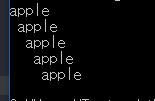
I want to display following print in Command line.
apple
  apple
    apple
      apple
        apple

Miss

However, This print is not able to display following code used print script.
def main():
    i = 0
    while i<5:
        print('apple')
        j = 0
        while j < i:
            print(' ')
            j = j + 1
        i = i + 1
if __name__ == '__main__':
    main()
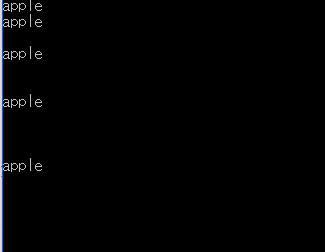
rusult…
enter image description here
Print code change line when writing new apple.

succeed

Please, look at following code.
import sys

def main():
    i = 0
    while i < 5:
        print('apple')
        j = 0
        while j <= i:
            sys.stdout.write(' ')
            j = j + 1
        i  = i + 1
if __name__ == '__main__':
    main()
sys.stdout.write is write string regardless of the changing line.
Result!
enter image description here
However, I give you a strong warning that sys.stdout.weite use only str.

Reference

https://www.lifewithpython.com/2013/12/python-print-without-.html

コメント

このブログの人気の投稿

ヘッセ行列

Introduction English ver 今日は、ヘッセ行列を用いたテイラー展開について書こうと思います。 これは最適化を勉強するにあたって、とても大事になってくるので自分でまとめて残しておくことにしました。とくに、機械学習では最適化を必ず行うため、このブログのタイトルにもマッチした内容だと思います。 . 概要 ヘッセ行列の定義 ベクトルを用いたテイラー展開 関数の最適性 ヘッセ行列の定義 仮定 f は次のような条件を満たす関数です。. f はn次元ベクトルから実数値を出力します。 このベクトルは次のように表せます。 \[x = [x_1,x_2,,,,x_n]\] \(\forall x_i , i \in {1,2,,,n}\), f は二回偏微分可能です。 定義 ヘッセ行列は \(\frac{\partial^2}{\partial x_i \partial x_j}を (i,j)要素に持ちます。\) よってヘッセ行列は次のように表せます。 \[ H(f) = \left( \begin{array}{cccc} \frac{\partial^ 2}{\partial x_1^2} & \frac{\partial^2 f}{\partial x_1 \partial x_2} & &\ldots \frac{\partial^2 f}{\partial x_1 \partial x_n} \\ \frac{\partial^ 2 f}{\partial x_1 \partial x_2} & \frac{\partial^ 2 f}{\partial x_2^ 2} & \ldots & \frac{\partial^2 f}{\partial x_2 \partial x_n} \\ \vdots & \vdots & \ddots & \vdots \\ \frac{\partial^ 2 f}{\partial x_n \partial x_2} & \frac{\partial^ 2 f}{\partial x_n \partial x_2} & \ldo...

Rolle’s theorem

Introduction 日本語 ver This post is written Rolle’s theorem. The mean-value theorem is proved by Rolle’s theorem. I will write Mean-value theorem at a later. I introduce Maximum principle because proving Rolle’s theorem need Maximum principle. Maximum principle It is very easy. f is continuous function on bounded closed interval.\(\implies\)** f have max value.** Proof This proof is difficult. I write this proof in other posts. Maximum Principle Rolle’s theorem f is continuous function on [a,b] and differentiable function on (a,b). \[f(a) = f(b) \implies \exists ~~c ~~s.t~~ f'(c) = 0 , a<c<b\] Proof f(x) is constant function \[\forall c \in (a,b) , f'(c) = 0\] else when \(\exists t ~~s.t~~f(a) < f(t)\), \(\exists c ~~s.t~~ \max f(x) = f(c)\) by Maximum principle I proof \(f'(c)=0\) f is differentiable on \(x = c\) and \(f(c) >= f(c+h)\). Thus \[f'(c) = \lim_{h \rightarrow +0} \frac{f(c+h) - f(c)}{h} \leq 0\] \[f'(c) = \lim...

Pythonでグラフ理論

Introduction English ver 今日はnetworkxというpythonのモジュールについて書きます。 グラフ理論の定義などの情報は ここ の記事に書いてあります。 この記事ではグラフ理論の中身については扱いませんが、Pythonでのnetworkxというモジュールについてメモをしておきます。 Networkx Python3にはnetworkxはすでに入っています。 Python2の方はpipを使ってinstallしてください。コマンドラインで以下のコマンドを実行します。 pip install networkx ではNetworkxを使ってグラフを作っていきます。 初めにimportをしてインスタンスを作っていきます。 import networkx as nx import matplotlib.pyplot as plt G = nx.Graph() 次にグラフにノード(頂点)とエッジ(枝)を入れていきます。 G.add_node(1) # add Multiple nodes G.add_nodes_from([2,3,4]) G.add_edge(1,2) # add Multiple edges G.add_edges_from([(3,4),(1,2),(4,6)]) ではこのGのグラフを描画していきましょう。 以下のコードで描画できます。 nx.draw(G) plt.show() Networkxはたくさんの関数を持っています。 また、随時追記していきたいと思います。 Reference https://qiita.com/kzm4269/items/081ff2fdb8a6b0a6112f http://akiniwa.hatenablog.jp/entry/2013/05/12/012459